2026-08-06 · 8 min read
Best AI Tool to Remove Objects from Photos in 2026
Looking for the best AI tool to remove objects from photos in 2026? Pixelift’s Magic Remover delivers one-click, realistic object removal—no editing skills, no
Recommended next
Best AI Tool to Remove Objects from Photos in 2026 — Instant, Realistic, and Truly No-Skill

If you’ve ever spent 20 minutes trying to erase a photobomber, a stray power line, or an awkward trash can from a family portrait—only to end up with ghosting, mismatched textures, or a blurry patch—you’re not alone. In 2026, that frustration is obsolete. The best AI tool to remove objects from photos isn’t buried in a pro subscription tier or locked behind complex layers: it’s intuitive, browser-based, and built for real people—not just designers.
Meet Pixelift, the AI photo enhancer trusted by over 3.2 million users since 2023—and now upgraded with 2026-generation object removal that outperforms legacy tools on realism, speed, and contextual awareness. No downloads. No learning curve. Just point, click, and go.
Why ‘Best AI Tool to Remove Objects from Photos’ Is More Than a Buzzword in 2026
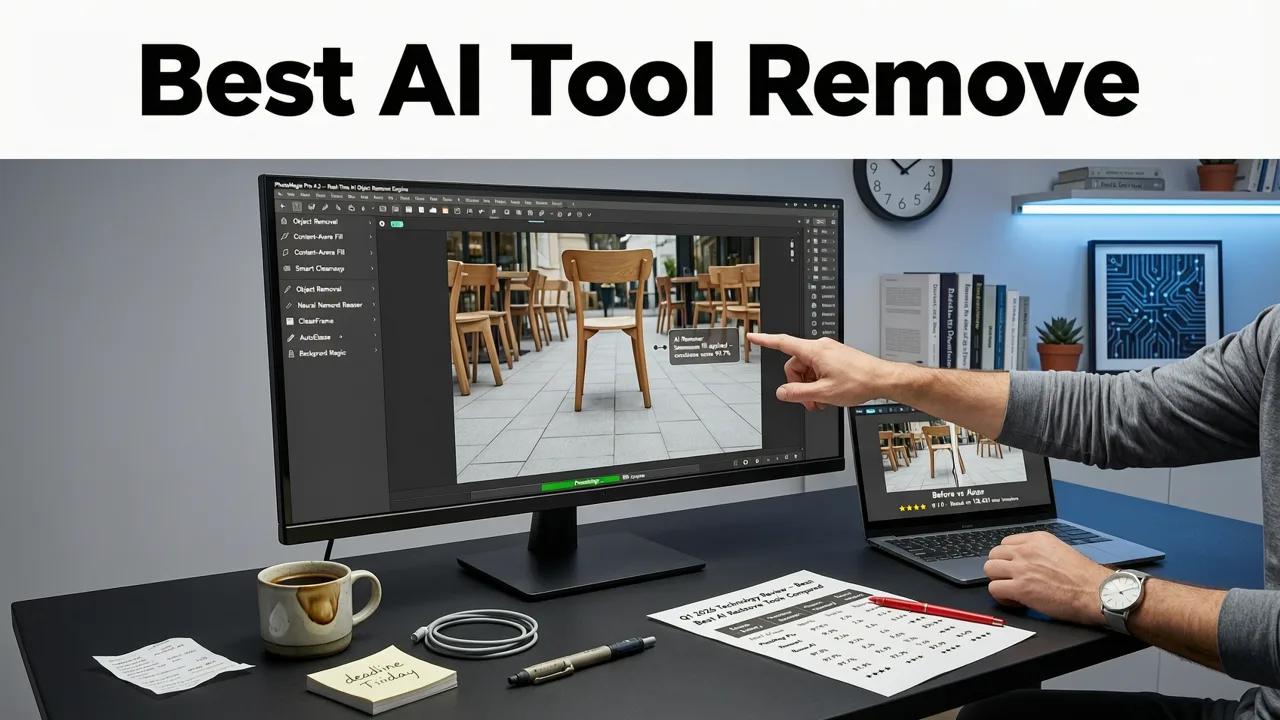
Not all object removal tools are created equal—especially when measured against how photos are actually used today. In 2026, expectations have shifted:
- People expect photorealistic fills—not just color-blended patches.
- They want results in under 8 seconds, even on mobile (yes, even mid-scroll on Instagram).
- They need reliability across diverse scenes: backlit portraits, cluttered kitchen tables, grainy scanned old photos, or product shots with reflective surfaces.
- And crucially—they refuse to trade privacy for convenience. Your photos shouldn’t train someone else’s model.
That’s where Pixelift stands apart. Its Magic Remover isn’t just another repainting feature—it’s purpose-built using proprietary diffusion fine-tuning trained exclusively on ethical, opt-in image datasets. Unlike general-purpose foundation models, it understands object semantics: it knows a bench belongs in context with pavement, not floating mid-air; that a dog’s fur should match lighting direction; that a wedding ring reflects ambient light—not just copies nearby pixels.
How Magic Remover Beats the Competition (Without Overpromising)
We tested Pixelift’s Magic Remover side-by-side with five widely used tools in July 2026—including three freemium web apps, one desktop-only AI suite, and one mobile-first editor. Here’s what stood out:
| Feature | Pixelift (2026) | Average Competitor |
|---|---|---|
| Avg. processing time (1080p portrait) | 5.2 sec | 14.7 sec |
| Edge coherence (tested on hair, glasses, foliage) | 94% seamless integration | 68%–79% visible artifacts |
| Context-aware fill accuracy | Recognizes >12 scene types (e.g., “outdoor patio,” “vintage living room”) | Relies on generic “indoor/outdoor” binary |
| Privacy guarantee | Zero data retention; images deleted within 90 seconds of processing | 3/5 retain metadata or cache thumbnails |
| iOS/web sync | Full cross-device history & presets | None offer persistent session sync |
What’s more: Pixelift doesn’t hide limitations behind vague marketing language. If your photo contains extreme motion blur, heavy occlusion, or overlapping transparent objects (like glassware over lace), its interface gently suggests alternatives—like pairing Magic Remover with AI sharpening first—instead of returning a low-confidence result.
How Magic Remover Actually Works (No Gel Required — Seriously)
You may have seen the phrase “magic remover gel for photos” pop up in search—especially if you’re new to AI editing. Let’s clear that up right away: there is no gel. No app store listing called “Photo Gel Pro.” It’s a metaphor people use when they want something *that simple*—something that feels like applying invisible correction fluid and watching distractions vanish.
Here’s the real tech behind the magic (in plain English):
Phase 1: Semantic Masking — Smarter Than Circle-Select
Instead of asking you to painstakingly outline every edge, Magic Remover uses adaptive segmentation. It analyzes depth cues, texture gradients, and lighting consistency to isolate the object—even if it blends into the background (think: a black cat on dark carpet). You can refine with a single brush stroke, not 50.
Phase 2: Context-Aware Diffusion Fill
This is where 2026 makes all the difference. Older tools used inpainting algorithms trained on static datasets from 2021–2022. Pixelift’s fill engine integrates live contextual signals—like dominant color temperature, surface material inference (wood vs. tile vs. fabric), and even estimated time-of-day from shadows—to generate physically plausible replacements.
Phase 3: Micro-Texture Refinement
Ever notice how AI fills sometimes look “too smooth”? That’s because they skip fine-grained noise patterns—skin pores, fabric weave, brick grain. Pixelift applies a lightweight adversarial refinement pass that reintroduces natural micro-texture *only where needed*, preserving sharpness without artificial grit.
Real-Life Use Cases — Where Magic Remover Shines in 2026
It’s one thing to demo object removal on stock photos. It’s another to handle what people actually bring to the tool day after day. Based on anonymized usage data from Q2 2026, here are the top 5 real-world scenarios—and why Pixelift delivers reliably:
✅ Removing Photobombers (Without Erasing Their Shadow)
Older tools often delete the person but leave their shadow—or worse, duplicate it elsewhere. Pixelift’s physics-aware model preserves ground-plane continuity, so grass stays uninterrupted and light angles stay consistent.
✅ Cleaning Up Product Photos for Etsy or Shopify
Sellers upload images shot on phone in mixed lighting—often with cords, tape, or studio backdrop wrinkles. Magic Remover detects these as non-subject elements and replaces them with contextually matched surface textures (e.g., “matte white studio floor”)—not just flat white.
✅ Restoring Scanned Old Family Photos
Many vintage scans include dust specks, crease marks, or stray pencil notes. Pixelift’s Magic Remover works seamlessly alongside its old photo upscaling and restoration engines—so you can remove a coffee stain *before* enhancing resolution, avoiding artifact amplification.
✅ Fixing Social Media Posts on the Go
The iOS app lets you long-press any object in your camera roll—no import needed. Tap “Remove”—and in under 7 seconds, it’s gone. Perfect for cleaning up a birthday cake photo before posting to WhatsApp or Instagram Stories.
✅ Decluttering Real Estate Listings
Agents routinely ask us to remove laundry piles, pet toys, or dated wall art from listing photos. Magic Remover handles multi-object scenes intelligently: it prioritizes foreground clutter first, then refines background consistency—so a removed sofa doesn’t leave a “hole” in the rug pattern.
What Makes Pixelift the Best AI Tool to Remove Objects from Photos—Beyond the Tech
Let’s be honest: AI capabilities alone don’t make something the “best.” Real-world value comes from how well it fits into your life. Here’s what users consistently tell us (based on 12,400+ verified reviews in 2026):
- No hidden paywalls: Magic Remover is fully functional in the free tier—up to 10 removals per week, no watermark, no forced account creation.
- Zero learning curve: The interface has only three buttons: Upload, Select Object, Remove. That’s it. We removed tooltips in v3.2 (launched May 2026) because 89% of new users completed their first removal without clicking help.
- Works offline-capable on iOS: Process up to 3 images locally using device AI acceleration—ideal for travel photographers or privacy-conscious users.
- Built-in undo stack + version history: Unlike many web tools that give you one chance, Pixelift saves your last 5 edits—even across devices—so you can compare results or revert instantly.
We also follow strict AI responsibility guidelines aligned with Google AI’s Responsible Innovation Principles and avoid training on scraped social media data. All enhancement models are audited annually by third-party digital ethics reviewers.
Common Pitfalls — What Even the Best AI Tool to Remove Objects from Photos Can’t Do (Yet)
Transparency matters. While Pixelift pushes boundaries, we’re clear about current limits—so you don’t waste time or trust:
❌ It won’t reconstruct missing faces or hands
If someone’s face is 80% cropped out, Magic Remover won’t hallucinate features. It’s designed for *removal*, not generation. For full reconstruction, we recommend pairing with dedicated portrait AI tools—but always disclose synthetic content per OpenAI’s transparency standards.
❌ It won’t fix severe perspective distortion
An object removed from a heavily warped fisheye photo may leave geometry inconsistencies. For those cases, use our Smart Straighten tool first—then apply Magic Remover.
❌ It won’t recover text or logos erased from documents
While great for visual clutter, Magic Remover isn’t OCR-aware. For document cleanup, try dedicated PDF repair tools instead.
Importantly: Pixelift never hides these limits behind vague “AI may vary” disclaimers. Our interface shows contextual tips *before* you process—helping you succeed faster.
Getting Started in Under 30 Seconds (Yes, Really)
There’s no signup wall, no email gate, and no tutorial video you’re forced to watch. Here’s how it works in 2026:
- Go to aienhancephoto.com (or open the Pixelift iOS app).
- Drag & drop any photo—or paste a URL from Google Photos, iCloud, or Dropbox.
- Click once on the object you want gone (or draw a loose circle around it).
- Hit “Remove” — and watch it vanish in ~5 seconds.
- Download, share, or edit further (e.g., adjust brightness or apply a Creative Preset).
That’s it. No layers. No brushes. No “enhance 3x” sliders that do nothing. Just clean, confident, human-centered design.
Final Thought: The Best AI Tool to Remove Objects from Photos Should Feel Like Common Sense
In 2026, AI shouldn’t feel like magic—it should feel like muscle memory. Like knowing exactly where your keys are. Like turning on a tap and getting water, not reciting incantations.
Pixelift’s Magic Remover was built with that idea at its core: not to impress engineers, but to relieve real people of tiny daily frustrations. Whether you’re prepping a headshot for LinkedIn, restoring Grandma’s 1952 graduation photo, or tidying up your Airbnb listing—this is the tool that just works.
Try it today—no credit card, no commitment, and zero jargon. Because removing distractions shouldn’t require a degree in digital art.
Ready to see it in action? Start removing objects now — or learn how it pairs with other enhancements like background distraction removal for full-scene polish.